
What Makes an Architecture Firm Truly “Best”? | Sutranj Architects Islamabad
Choosing the best architecture firm in Islamabad goes beyond visual appeal. A truly exceptional firm combines innovative architectural design, sustainability, technical expertise, and client-focused planning. Islamabad’s planned urban landscape demands architects who understand both modern design principles and environmental responsibility.
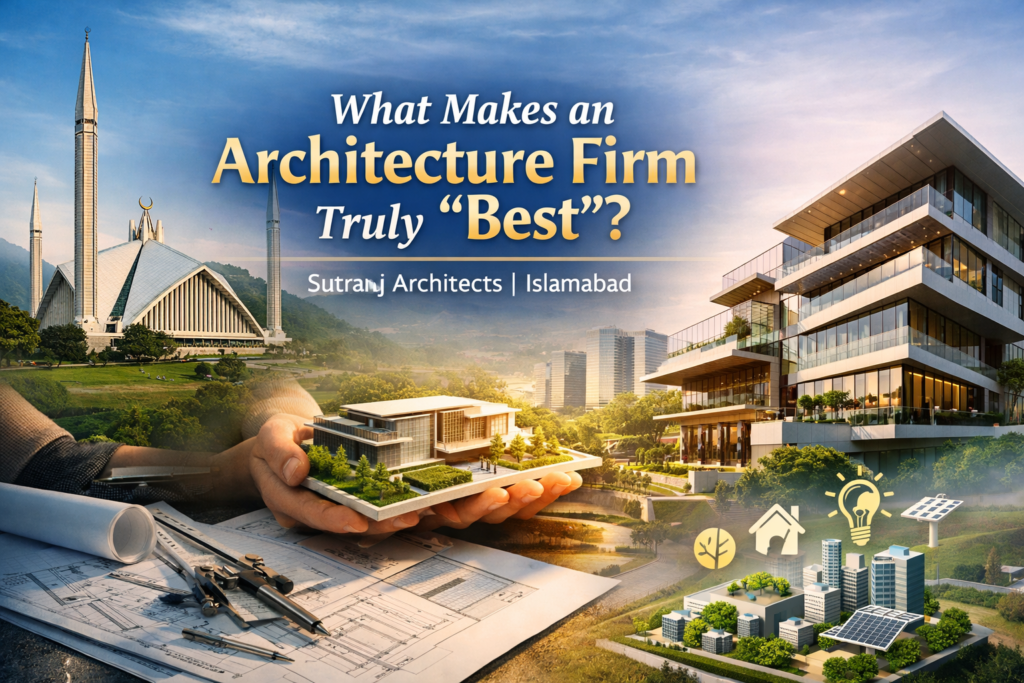
At Sutranj Architects, we specialise in residential, commercial, and sustainable architecture in Pakistan, delivering thoughtful designs that balance aesthetics with functionality. Our approach emphasises green building strategies, efficient space planning, and contextual design tailored to Islamabad’s unique terrain.
What sets top architects apart is clear:
Effective communication, mastery of modern tools such as BIM, and a commitment to long-term value. Explore our Architecture Portfolio in Islamabad to see how design excellence translates into real-world impact.
Whether you’re planning a modern home, commercial development, or urban project, partnering with the right architectural firm ensures your vision is built with clarity, creativity, and purpose.
A Deep Look into Islamabad’s Architectural Evolution & Design Excellence
Islamabad is unlike any other city in Pakistan. Conceived not through organic sprawl but through deliberate planning, it stands as a living experiment in modern urban design. Nestled against the Margalla Hills, Islamabad blends geometry with nature, order with openness, and tradition with innovation. At the heart of this evolving city lies architecture — not just as buildings, but as a reflection of values, aspirations, and identity.
As the capital continues to grow, one question becomes increasingly relevant for homeowners, developers, and institutions alike: what truly makes an architecture firm the “best”? Is it iconic design, technical expertise, sustainability, or the ability to understand people and place?
At Sutranj Architects, we believe the answer lies in the balance of all these elements. To understand what defines architectural excellence today, we must first understand Islamabad itself.
Islamabad: A City Designed with Purpose
Unlike older cities shaped by centuries of layered growth, Islamabad was envisioned as a purpose-built capital — a symbol of Pakistan’s modern ambitions after independence. In the late 1950s and early 1960s, the government sought a city that would represent progress, neutrality, and national unity.
Greek architect and urban planner Constantinos Apostolou Doxiadis was commissioned to design the master plan. His approach was revolutionary for the region. Instead of dense congestion, he proposed a triangular grid system, dividing the city into clearly defined sectors, each with its own residential, commercial, and civic functions.
What set Islamabad apart was its emphasis on:
Green belts and open spaces
Low-density development
Separation of pedestrian and vehicular movement
Integration with natural topography
These principles continue to shape Islamabad’s architectural DNA and influence how modern architecture firms approach design today.
Architectural Identity: Where Modernism Meets Tradition
In its early decades, Islamabad’s architecture leaned heavily toward modernism — clean lines, functional forms, and institutional clarity. Government buildings reflected efficiency and authority rather than ornamentation.
However, as the city matured, its architectural identity evolved. Local architects and international designers began blending modern design language with Islamic, regional, and cultural influences, creating a more nuanced architectural character.
Landmark Structures that Define Islamabad
Some of Islamabad’s most iconic buildings demonstrate this synthesis:
Faisal Mosque
Designed by Turkish architect Vedat Dalokay, the Faisal Mosque broke away from traditional domes and minarets, adopting a tent-like structure inspired by Bedouin forms. It remains a global symbol of modern Islamic architecture.Pakistan Monument
A sculptural representation of national unity, blending symbolism with contemporary form.Parliament House
Designed by Edward Durell Stone and later refined by local architects, it reflects international collaboration and modern civic architecture.
These landmarks set the tone for future architectural exploration — encouraging creativity without losing cultural grounding.
What Defines the “Best” Architecture Firm Today?
In a city as thoughtfully planned as Islamabad, architectural excellence demands more than visual appeal. The best architecture firms share several defining characteristics:
1. Contextual Design Understanding
Great architecture responds to site, climate, culture, and user behavior. In Islamabad, this means respecting zoning laws, views of the Margalla Hills, sun orientation, and neighborhood character.
2. Client-Centered Approach
The best architects listen. They translate client aspirations into functional spaces, balancing budget, timeline, and long-term usability.
3. Technical Expertise
From structural coordination to building bylaws and construction detailing, technical competence ensures designs are not just beautiful, but buildable.
4. Sustainability & Responsibility
With rising environmental challenges, sustainable architecture is no longer optional. Energy efficiency, water management, and material responsibility are essential markers of quality.
5. Innovation & Technology
Leading firms embrace tools like BIM (Building Information Modeling), 3D visualization, and digital workflows to improve accuracy, collaboration, and outcomes.
At Sutranj Architects, these principles form the foundation of every project — whether residential, commercial, or urban-scale.
Islamabad’s Architecture Firms: The Current Landscape
Today, Islamabad is home to a growing number of architecture and design firms handling everything from private residences to large mixed-use developments. While styles and scales may differ, top firms are united by a commitment to innovation, professionalism, and sustainability.
Most leading architecture firms in Islamabad now offer:
Architectural design & planning
Interior architecture
Landscape integration
Urban and town planning
Sustainable design consulting
What distinguishes the best among them is clarity of vision and consistency of execution — delivering quality across every stage of a project.
Challenges Shaping Islamabad’s Built Environment
Despite its strong planning foundation, Islamabad faces several architectural and urban challenges today.
1. An Outdated Master Plan
Perhaps the most pressing issue is that Islamabad’s master plan — intended to be revised every 20 years — has not been comprehensively updated since the 1960s. This disconnect between planning and reality has led to:
Urban sprawl
Encroachment on green areas
Inconsistent development patterns
2. Rapid Population Growth
Population pressure has increased demand for housing, infrastructure, and services, often outpacing planning controls. This creates strain on water resources, roads, and utilities.
3. Zoning & Enforcement Issues
Weak enforcement has allowed unauthorized developments, commercial intrusion into residential zones, and loss of public spaces.
4. Sustainability Pressures
Architects now face the challenge of delivering cost-effective projects while meeting rising expectations for energy efficiency and environmental responsibility.
Navigating these constraints requires architects who are not just designers, but strategic problem-solvers.
The Future of Architecture in Islamabad
Despite these challenges, Islamabad’s future remains full of opportunity.
Smart City Vision
Islamabad is moving toward smart urban management — integrating technology for traffic control, security, and infrastructure optimization. Developments like Capital Smart City and the New Blue Area signal a shift toward high-tech, mixed-use environments.
Sustainable Architecture as a Standard
Future architecture in Islamabad will increasingly incorporate:
Solar energy systems
Passive cooling strategies
Rainwater harvesting
Green roofs and biophilic design
Sustainability will define architectural credibility.
Technology-Driven Design
Advanced tools are transforming the profession:
BIM improves coordination and reduces errors
VR/AR allows clients to experience spaces before construction
AI-assisted design supports smarter planning decisions
Modular construction speeds up delivery while reducing waste
Firms that adapt to these technologies will shape the next generation of Islamabad’s skyline.
Sutranj Architects: Designing with Vision & Responsibility
At Sutranj Architects, we see architecture as more than structures — it is storytelling through space. Our approach combines:
Contemporary architectural language
Deep respect for context
Sustainable design strategies
Client-focused collaboration
From private residences to commercial and institutional projects, we aim to create architecture that is timeless, functional, and environmentally responsible.
Our work reflects Islamabad’s evolving identity — modern yet grounded, innovative yet respectful of nature and culture.
Conclusion: Building the Future, Thoughtfully
Islamabad is a city in motion — shaped by bold planning ideals, challenged by modern realities, and driven by a future that demands sustainability and innovation.
The architecture firms that will truly define its next chapter are those that combine vision with responsibility, creativity with discipline, and technology with humanity.
Choosing the “best” architecture firm is ultimately about choosing a partner who understands not just how to build, but why we build.
At Sutranj Architects, we are proud to contribute to Islamabad’s architectural journey — one thoughtful design at a time.